

Blog
Case studies, strategies, and ideas shaping modern technology.
Why Cloud Optimisation Fails Without True Observability
Cloud optimisation initiatives have become increasingly common across organisations, yet the results rarely match expectations. Despite investments in tooling, dashboards, and automation, inefficiencies persist, costs continue to rise, and engineering teams remain constrained by complexity.
The issue is not a lack of effort.
It is a lack of understanding.
Most organisations are attempting to optimise cloud environments that they cannot fully see, interpret, or reason about. Without true observability, optimisation becomes reactive, inconsistent, and often counterproductive.
This is the third instalment of our Cloud Maturity Series. In Part 1: A Strategic Guide to Cloud Maturity in 2026, we explored the foundational shifts required to build resilient, high-performing cloud organisations. In Part 2: How Cloud Complexity Quietly Consumes Your Budget, we examined the structural drivers behind rising cloud costs and inefficiencies.
In this article, we go one level deeper, exploring why optimisation efforts fail even when organisations are actively trying to control spend.
The Optimisation Illusion: Visibility Without Insight
Most organisations today have no shortage of data. Metrics, logs, traces, cost dashboards, and alerts are readily available across multiple platforms. On the surface, it looks like strong visibility.
In reality, that visibility is fragmented and difficult to interpret.
Teams can see what is happening across their systems, but not why it is happening. They can identify expensive workloads, but cannot tell whether those workloads are actually delivering value. They can detect anomalies, but tracing them back to a clear root cause is often slow, unclear, or inconclusive.
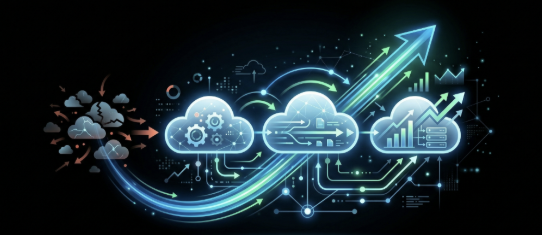
This gap between seeing and understanding creates a dangerous illusion of control.
As a result, cloud optimisation becomes a surface-level exercise focused on what is easiest to act on:
- Reducing instance sizes
- Cleaning up idle resources
- Adjusting storage tiers
These actions can deliver quick, visible savings, but they rarely address the deeper causes of cost and inefficiency, such as architectural decisions, workload patterns, or lack of ownership.
Over time, the same issues return, often in slightly different forms. Costs rise again, complexity increases, and teams repeat the same optimisation cycle.
Without real insight into how systems behave and deliver value, optimisation efforts remain short-lived.
Observability vs Monitoring: A Critical Distinction
A core issue lies in the widespread confusion between monitoring and observability.
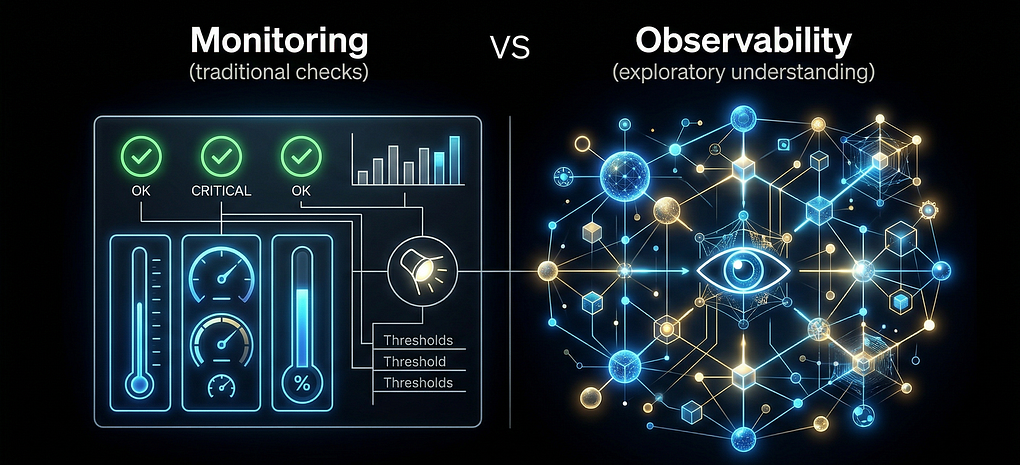
Monitoring focuses on known conditions:
- Predefined dashboards
- Static thresholds
- Alerting on expected failures
Observability, by contrast, is designed for complexity:
- Understanding unknown failures
- Exploring system behaviour dynamically
- Connecting technical signals to business outcomes
In low-complexity systems, monitoring is sufficient.
In modern cloud environments, distributed, dynamic, and increasingly AI-driven, it is not.
Organisations relying solely on monitoring are effectively navigating with a map of yesterday’s problems.
Where Optimisation Breaks Down
Cloud optimisation fails not because organisations lack tools, but because critical gaps exist in how systems are observed and understood.
1. The Context Gap
Cost data is rarely connected to value.
A service may appear expensive, but without context, it is impossible to determine:
- Whether it supports revenue-generating features
- Whether it handles critical workloads
- Whether it compensates for inefficiencies elsewhere
Optimisation decisions made without context risk reducing cost at the expense of performance or user experience.
2. The Ownership Gap
Unowned systems are rarely optimised.
Across many cloud estates:
- Services lack clear ownership
- Teams inherit workloads without full understanding
- Responsibility is distributed, but accountability is not
This leads to hesitation. Even when inefficiencies are identified, teams are reluctant to act due to uncertainty and risk.
As a result, waste persists not because it is invisible, but because it is organisationally ambiguous.
3. The Granularity Gap
Telemetry is often either insufficient or overwhelming.
Common scenarios include:
- High-level metrics without traces, limiting root cause analysis
- Excessive logging without structure, creating noise
- Unfiltered traces that generate cost without insight
In both cases, the outcome is the same: decision-making lacks precision.
Optimisation requires clarity, not volume.
4. The Feedback Gap
Insight arrives too late to be useful.
Typical feedback cycles include:
- Monthly cost reviews
- Post-incident analysis
- Retrospective performance evaluations
In fast-moving cloud environments, delayed feedback results in missed opportunities and repeated inefficiencies.
By the time action is taken, the system has already evolved.
The Observability Tax
In an effort to improve visibility, organisations often over-invest in telemetry.
Multiple logging systems, excessive trace retention, and duplicated monitoring tools lead to significant cost overhead.
This creates the Observability Tax:
Spending heavily on data collection without proportional decision-making value.
The consequences are twofold:
- Increased cloud spend due to storage and processing of telemetry
- Increased cognitive load on engineers attempting to interpret it
Observability, when poorly implemented, becomes part of the problem it is meant to solve.
The Real Drivers of Ineffective Optimisation
Several systemic issues contribute to ongoing optimisation challenges:
Fragmented Tooling
Different teams use different observability stacks, leading to inconsistent visibility and duplicated effort.
Impact:
Insights are siloed, making it difficult to form a unified view of system behaviour and cost drivers.
Disconnected Cost and Performance Data
Cost metrics are analysed separately from performance and usage data.
Impact:
Optimisation decisions lack context, resulting in trade-offs that may harm system reliability or user experience.
Reactive Operating Models
Organisations rely on retrospective analysis rather than real-time insight.
Impact:
Issues are addressed after they occur, rather than prevented through proactive design.
Cognitive Overload
Engineers must interpret vast amounts of telemetry across multiple tools.
Impact:
Decision-making slows, errors increase, and optimisation efforts become less effective.
Platform Engineering: Enabling True Observability
Platform engineering addresses these challenges by embedding observability directly into the developer experience.
Rather than expecting teams to assemble their own tooling, platform engineering provides a standardised foundation where observability is built in by default.
This includes:
- Unified telemetry pipelines
- Standardised dashboards aligned to golden paths
- Integrated cost visibility at the workload level
- Automated anomaly detection and alerting
By centralising observability capabilities, organisations eliminate fragmentation and ensure consistency across teams.
How Platform Engineering Improves Optimisation
The Thinnest Viable Platform (TVP)
A streamlined platform layer standardises observability alongside identity, compliance, and infrastructure.
Impact:
Developers gain immediate, consistent visibility without additional setup, reducing cognitive load and improving decision-making.
Observability-as-Code
Telemetry, alerts, and dashboards are defined within infrastructure and deployment pipelines.
Impact:
Observability becomes repeatable, version-controlled, and consistent across environments.
Real-Time Cost Visibility
Cost data is integrated directly into development and deployment workflows.
Impact:
Engineers can see the financial impact of their decisions immediately, enabling proactive optimisation.
Actionable Telemetry
Data collection is aligned with decision-making needs rather than volume.
Impact:
Noise is reduced, and insights become clearer and more relevant.
From Reactive Optimisation to Continuous Intelligence
High-maturity organisations do not treat optimisation as a periodic exercise.
They embed it into daily operations.
This shift includes:
- Continuous feedback loops
- Real-time insight during development
- Automated enforcement of efficiency standards
Optimisation becomes a natural outcome of system design, rather than a corrective activity.
The Role of AI in Observability
AI is increasingly used to enhance observability by:
- Detecting anomalies across large datasets
- Identifying patterns in system behaviour
- Suggesting optimisation opportunities
However, AI depends on high-quality inputs.
Without structured telemetry, clear ownership, and contextual data, AI-driven insights lack reliability. Instead of improving decision-making, they risk amplifying confusion.
AI is an accelerator, not a replacement for observability fundamentals.
Athena: Enabling True Cloud Observability and Optimisation
Cloud optimisation initiatives fail when teams lack a holistic understanding of their systems. Mesoform’s Athena Internal Developer Platform bridges this gap by embedding observability and cost intelligence directly into developer workflows, turning optimisation from reactive guesswork into a strategic capability.
How Athena Transforms Observability
Athena operationalises platform engineering and continuous intelligence principles:
- Unified Observability Across Multi-Cloud Environments
Athena consolidates telemetry from all cloud workloads, eliminating silos and fragmentation. Engineers gain a single source of truth for metrics, traces, and logs, making it easier to understand system behaviour and identify inefficiencies. - Real-Time Cost Visibility
Cost data is integrated into IDP delivered dashboards automatically. Teams can see the financial impact of architectural and deployment decisions throughout the development lifecycle, enabling proactive optimisation rather than reactive cost-cutting. - Curated Developer Experiences
Athena provides pre-configured dashboards, alerts, and telemetry aligned with business outcomes. This reduces cognitive load, letting developers focus on solving problems rather than assembling tools or interpreting raw data. - Actionable Insights, Not Noise
Athena prioritises high-value telemetry, linking technical signals to business impact. By filtering irrelevant data, it ensures teams make informed decisions with precision. - Continuous, Data-Driven Optimisation
Optimisation becomes a natural, ongoing process. Athena facilitates feedback loops, automated enforcement of efficiency standards, and integration with AI-driven insights where appropriate.
The Athena Advantage
Athena directly addresses the gaps that undermine cloud optimisation:
- Context Gap: Connects cost and performance data to business value.
- Ownership Gap: Clarifies responsibilities, enabling confident optimisation decisions.
- Granularity Gap: Provides precise, actionable telemetry instead of overwhelming volume.
- Feedback Gap: Delivers insights in real-time for timely, impactful decisions.
From Reactive to Strategic Optimisation
With Athena, organisations can:
- Make data-driven decisions with confidence
- Reduce cloud waste without sacrificing performance
- Maintain sustained engineering velocity and system resilience
Athena turns observability from a cost and complexity burden into a competitive advantage, operationalising the full potential of platform engineering and continuous intelligence.
Conclusion: Optimisation Requires Understanding
Cloud optimisation is not a tooling challenge; it is a visibility and understanding challenge. Without observability:
- Cost data lacks context
- Performance issues lack explanation
- Optimisation efforts remain reactive
With observability:
- Systems become understandable
- Decisions become informed
- Optimisation becomes continuous
Organisations that succeed in 2026 will not be those with the most data, but those with the clearest insight. Because ultimately, effective optimisation depends on one simple principle:
You cannot improve what you do not understand.
Athena provides the foundation to move beyond guesswork, making continuous, data-driven cloud optimisation a reality.
For more information, explore Athena here: https://athena.mesoform.com/
