

Blog
Case studies, strategies, and ideas shaping modern technology.
Cloud Portability: The Budget Safeguard Most Organisations Ignore

This final instalment closes the Mesoform Cloud Maturity series by shifting the focus from how organisations adopt the cloud to how much control they actually retain once they are there. Across the previous articles, we examined the strategic foundations of cloud maturity, the hidden cost pressures of complexity, and the operational gaps exposed by insufficient observability.
In this final chapter, we turn to the most overlooked factor in modern cloud architecture: portability and data management, and why it now defines long-term control more than initial cloud adoption ever could.
In the pursuit of speed, convenience, and rapid deployment, many organisations have unknowingly constructed digital dependencies so deep that they resemble permanent infrastructure rather than strategic tooling. Over time, this creates Vendor Gravity: the gradual loss of negotiating power caused by over-reliance on a single cloud ecosystem.
Once critical workloads, pipelines, and datasets become deeply embedded into provider-specific services, flexibility disappears. Costs become increasingly difficult to control because the business no longer has a realistic ability to move. At that point, your cloud provider stops competing for your business; your architecture has already decided for you.
True cloud maturity requires more than scalability and uptime. It requires optionality. The ability to migrate workloads or relocate data without triggering a multi-year transformation programme is a financial control mechanism that most teams ignore until it is too late.
The Illusion of the “Native” Discount
One of the most common justifications for deep cloud lock-in is the promise of lower operational costs through “native” tooling. Providers encourage organisations to adopt proprietary databases and serverless architectures under the banner of efficiency.
Initially, those savings appear real. However, these efficiencies are usually front-loaded. As organisations scale, data volumes grow into petabytes, and network egress charges begin compounding. Re-platforming costs become prohibitively high, and even modest pricing changes can have massive financial implications because migration is no longer commercially viable.
The organisations with the strongest negotiating position are rarely the ones actively migrating; they are the ones architecturally capable of doing so.
Platform Engineering: The Foundation of Portable Infrastructure
The rise of Platform Engineering has emerged as the primary response to cloud sprawl and operational fragmentation. In mature cloud organisations, developers are increasingly insulated from the complexity of underlying providers through Internal Developer Platforms (IDPs).

By treating the cloud as an interchangeable resource provider rather than the centre of the operating model, a well-designed platform engineering strategy allows organisations to:
- Standardise Operations Across Environments: Security policies and deployment practices are applied consistently across multiple providers, reducing operational drift.
- Decouple Applications from Infrastructure: When teams build against platform interfaces instead of proprietary services, the underlying "plumbing" can be swapped out without refactoring the application code.
- Automate Governance: Platform Engineering embeds compliance directly into deployment pipelines, ensuring that regulatory controls travel with the workload rather than remaining tied to a specific vendor’s console.
The Athena Strategy: Decoupling Data from Compute
While compute portability has improved through containers and orchestration platforms, data remains the main constraint. Applications can be moved with relative ease, but data continues to anchor organisations to specific providers, tooling, and operating models.
This is where Athena changes the dynamic.
Athena is an internal developer platform designed to unify multi-cloud operations into a single control layer. Instead of teams navigating fragmented cloud tooling, it abstracts infrastructure, security, compliance, and observability into a consistent platform experience.
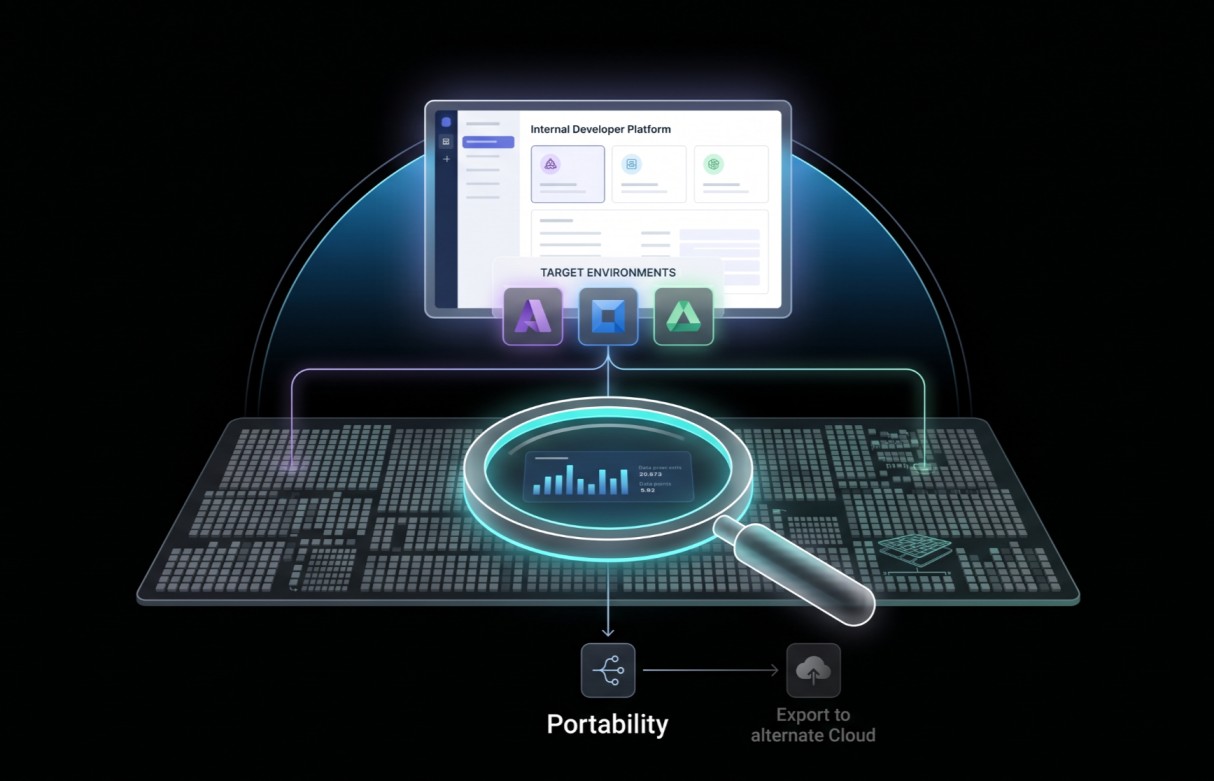
What Athena does in practice
- Unifies multi-cloud operations into a single control plane
- Abstracts infrastructure complexity, so teams do not interact directly with provider-specific services
- Standardises security, compliance, and observability across environments
- Shifts operational responsibility into the platform, reducing cognitive load on engineering teams
- Supports consistent deployment patterns regardless of the underlying cloud provider
By embedding these capabilities, Athena reduces the operational fragmentation that typically drives cloud lock-in.
Rather than each team building around specific cloud services, they build against a consistent platform interface. This makes underlying infrastructure far more interchangeable and significantly improves portability.
Why this matters for portability
- Reduces dependency on single-provider services by enforcing a consistent abstraction layer
- Improves workload mobility across environments without major refactoring
- Encodes governance and compliance into delivery pipelines, rather than external tooling
- Enables self-service infrastructure, reducing reliance on centralised DevOps bottlenecks
- Maintains velocity without increasing architectural coupling
The outcome is not just operational simplification. It is structural flexibility.
By decoupling teams from provider-specific complexity, Athena makes portability a practical operating model rather than an aspirational design goal, ensuring organisations can evolve their cloud environments without being constrained by them.
Strategic Data Management: Beyond Backup and Recovery
In 2026, mature data management is defined by lifecycle awareness. It introduces a shift in mindset where organisations must account for:
- Egress Budgeting: Modeling the “cost to leave” during the initial design phase to ensure portability remains economically achievable.
- Open Standards by Default: Prioritising interoperable formats to prevent format-level lock-in at the storage layer.
- Edge-Aware Processing: Shifting processing closer to the data source to reduce bandwidth dependency and the financial burden of large-scale data movement.
Conclusion: Building a Sovereign Cloud Future

Cloud Portability is the final expression of true cloud maturity because it represents independence. It is the ability to evolve infrastructure without rewriting the business around it.
By combining Platform Engineering and portable operational models, organisations can build environments capable of adapting to shifting market conditions without sacrificing performance.
The Mesoform Cloud Maturity Model was designed to help organisations move from reactive cloud consumption to deliberate cloud strategy. Portability is not simply a technical objective; it is operational resilience and financial leverage.
Is your data holding your budget hostage?
Mesoform helps organisations design portable, high-performance cloud platforms that reduce dependency, control spend, and restore strategic flexibility.
Explore our services and start building a sovereign cloud future today.
